

Introduction
Crystal units have a wide range of specifications, including not only frequency and size, but also load capacitance, frequency tolerance, frequency-temperature characteristics, and equivalent series resistance (ESR).
This may raise questions such as, "Can I use any crystal unit as long as the frequency is the same?" or "Which specifications should I check in the datasheet?"
A crystal unit is a passive component used in combination with an oscillation circuit. Therefore, to achieve stable oscillation, it is important to select a product that not only provides the required frequency but is also suitable for the IC, oscillation circuit, and operating environment in which it will be used.
This article explains the key points to consider when selecting a crystal unit.
Key Points to Check When Selecting a Crystal Unit
When selecting a crystal unit, the following specifications should generally be checked.
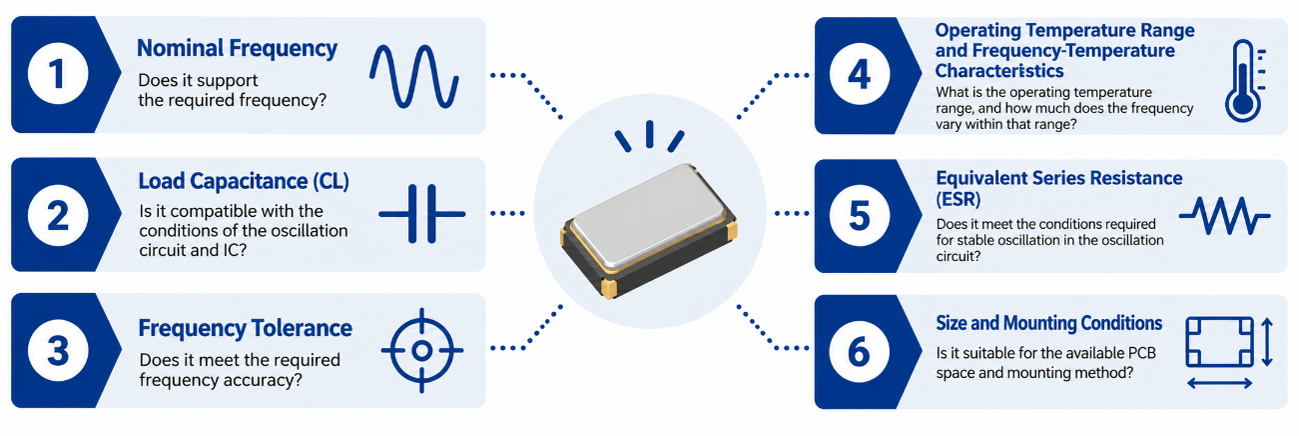
| Selection Criterion | Key Point to Check |
|---|---|
| Nominal frequency | Does it support the required frequency? |
| Load capacitance (CL) | Is it compatible with the conditions of the oscillation circuit and IC being used? |
| Frequency tolerance | Does it meet the required frequency accuracy? |
| Operating temperature range and frequency-temperature characteristics |
What is the required operating temperature range, and how much does the frequency vary within that range? |
| Equivalent series resistance (ESR) | Does it meet the conditions required for stable oscillation in the oscillation circuit? |
| Size and mounting conditions | Is it suitable for the available PCB space and mounting method? |
It is important to consider all of these conditions and select a crystal unit that is appropriate for the intended application and oscillation circuit. Let's take a closer look at each point.
1. Check the Required Nominal Frequency
The first specification to check when selecting a crystal unit is its nominal frequency.
The nominal frequency is the specified frequency value of the crystal unit.
Electronic devices require a reference frequency appropriate for their application in order to operate ICs, communication systems, and other components with the correct timing.
For example, if the required frequency is specified in the datasheet of the IC being used, select a crystal unit that meets that requirement.
However, a crystal unit cannot necessarily be used simply because its nominal frequency matches the required frequency.
The actual oscillation frequency is affected not only by the crystal unit itself but also by the conditions of the oscillation circuit in which it is used. Therefore, it is important not to select based on frequency alone, but also to check other conditions, such as the load capacitance described below.
2. Check the Load Capacitance (CL) to Match the Oscillation Circuit
One of the key specifications of a crystal unit is its load capacitance (CL).
Load capacitance is the capacitance specified as an operating condition when a crystal unit is used in an oscillation circuit.
Because the oscillation frequency varies with the load capacitance, it is important to select a crystal unit whose specified load capacitance (CL) matches the effective load capacitance of the oscillator circuit.
In a typical oscillation circuit, capacitors are often connected to the crystal unit to adjust the frequency. However, load capacitance is not determined solely by the external capacitors. The load capacitance is also affected by stray capacitance from PCB traces and the internal capacitance of the IC used in the circuit.
Therefore, when selecting a crystal unit, it is important to check the datasheet of the IC being used and the circuit configuration, and to select a product with an appropriate load capacitance for the oscillation circuit.
3. Check the Frequency Tolerance According to the Required Accuracy
The next specification is frequency tolerance.
Frequency tolerance indicates how much the actual frequency of a crystal unit is permitted to deviate from its nominal frequency. It is generally expressed in ppm (parts per million), where 1 ppm means one part per million.
For example, for a crystal unit with a nominal frequency of 20 MHz and a frequency tolerance of ±20 ppm, 20 MHz × 20 ppm = 400 Hz. Therefore, the allowable frequency range is 19.9996 MHz to 20.0004 MHz.
The required frequency accuracy varies depending on the electronic device, communication standard, and other system requirements.
When selecting a crystal unit, check the frequency deviation permitted by the system and select a product with a frequency tolerance that meets that requirement.
4. Check the Frequency-Temperature Characteristics and Operating Temperature Range for the Intended Environment
The frequency of a crystal unit changes slightly with ambient temperature. Frequency-temperature characteristics describe how the frequency changes in response to temperature changes. The operating temperature range, on the other hand, is the range of temperatures within which the crystal unit can operate while meeting its specified characteristics.
For example, equipment used in demanding temperature environments, such as automotive or space applications, requires different temperature specifications from equipment used indoors, such as PCs and home routers.
Therefore, when selecting a crystal unit, first confirm that its operating temperature range is suitable for the intended environment. Then check its frequency-temperature characteristics to ensure that the frequency variation within that temperature range meets the required accuracy.
5. Check the Equivalent Series Resistance (ESR) for Stable Oscillation
Another important specification for achieving stable oscillation is equivalent series resistance (ESR).
ESR is an electrical resistance value that represents the difficulty of sustaining the mechanical vibration of a crystal unit.
The higher the ESR, the greater the oscillation capability required from the oscillation circuit to sustain oscillation.
Therefore, when selecting a crystal unit, it is important not to consider the ESR value alone, but also to verify that stable oscillation can be achieved with the oscillation circuit in which the crystal unit will actually be used.
Because ESR varies depending on factors such as product size and frequency, check the product specifications and evaluate the crystal unit in combination with the actual oscillation circuit.
6. Check the Size and Mounting Conditions
As electronic devices become smaller, crystal units are also required to become increasingly compact.
Crystal units are available in a variety of package sizes and must be selected according to the mounting space available on the PCB.
However, this does not mean that simply selecting the smallest product is always the best choice.
Even at the same frequency, electrical characteristics differ depending on the product size.
Therefore, it is important to consider factors such as:
- Available mounting space on the PCB
- Required frequency
- Electrical characteristics
- Operating temperature environment
- Matching with the oscillation circuit
Also, be sure to check the recommended conditions for each product, including soldering and other mounting requirements.
7. Check the Oscillation Circuit After Selecting a Crystal Unit
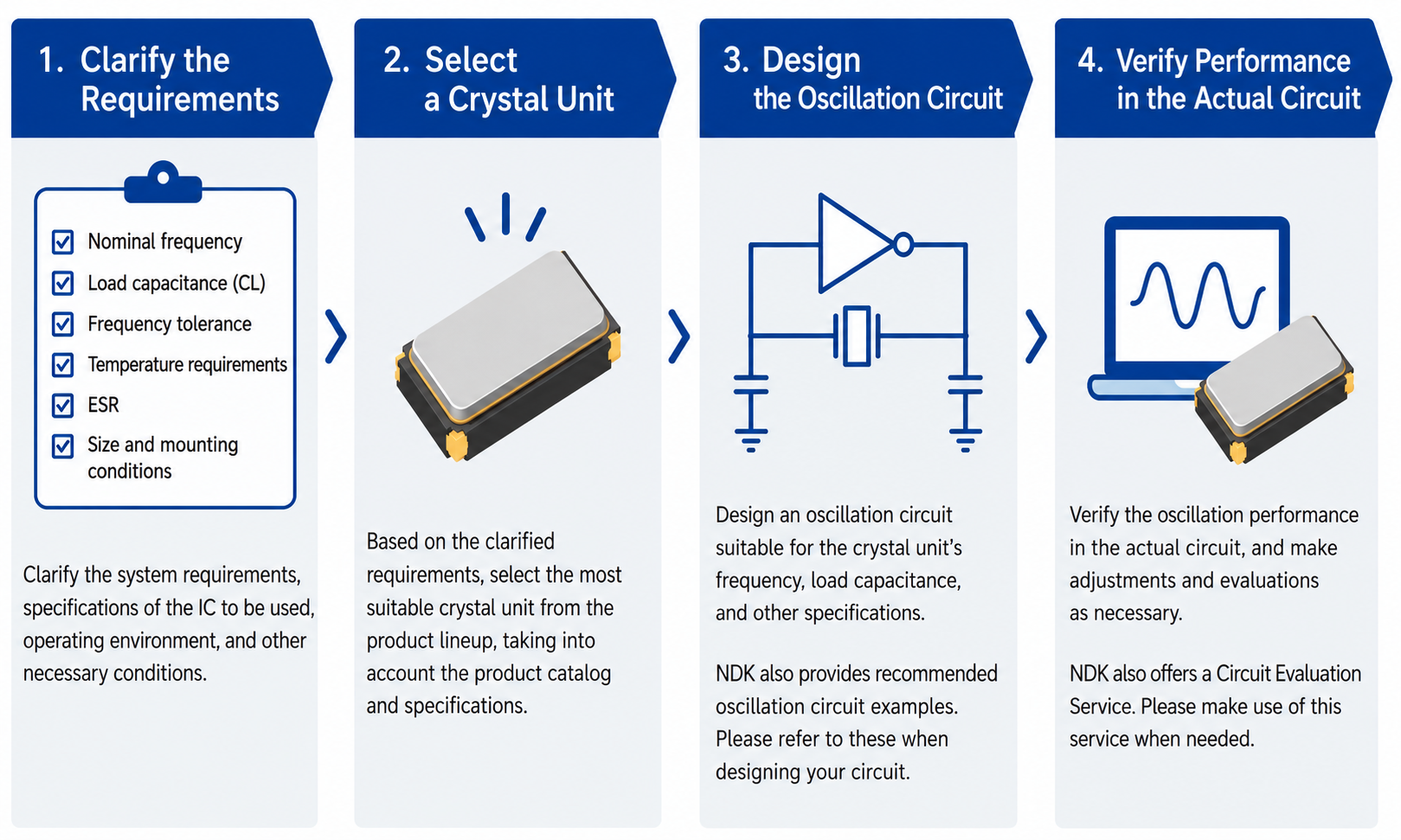
After selecting suitable crystal units based on the specifications described above, it is also important to evaluate the oscillation circuit in which the crystal unit will actually be used.
A crystal unit does not oscillate by itself. It is used in combination with an oscillation circuit consisting of an IC and other components. Therefore, it is necessary to consider not only the specifications of the crystal unit but also the IC being used and the circuit conditions.
Designing the Oscillation Circuit
When designing an oscillation circuit, consider the frequency, load capacitance, ESR, and other characteristics of the crystal unit when selecting the circuit configuration.
NDK provides examples of recommended oscillation circuits for use with crystal units. These reference designs cover various frequency ranges and oscillation modes. They can serve as a useful reference when designing an oscillation circuit.
Recommended Oscillation Circuit Examples for Crystal Units (Reference Designs)
Check Matching with the Actual Oscillation Circuit
Reference designs are useful when considering an oscillation circuit. However, in an actual product, oscillation characteristics may vary depending on factors such as the IC being used, component values, and the circuit layout on the PCB.
Therefore, it is ultimately important to verify the matching between the crystal unit and the actual circuit in which it will be used.
NDK offers a Circuit Evaluation Service to check and evaluate combinations of customers' circuits and crystal units.
If you need assistance with matching a crystal unit to an oscillation circuit or selecting an appropriate crystal unit, please make use of NDK's Circuit Evaluation Service.
NDK Circuit Evaluation Service for Stable Oscillation
Find a Crystal Unit Based on the IC Being Used
If the IC to be used has already been selected, it is also important to check the compatibility between the IC and the crystal unit.
NDK provides IC Matching Information, which allows you to find compatible crystal units based on criteria such as the IC manufacturer and IC part number.
Please use this information when considering a crystal unit suitable for your IC.
8. Checklist for Selecting a Crystal Unit
Finally, here is a summary of the main points to check when selecting a crystal unit.
1. What nominal frequency is required?
Check the frequency required by the IC or system being used.
2. What load capacitance (CL) is appropriate for the oscillation circuit?
Consider not only external capacitors but also the internal capacitance of the IC and stray capacitance.
3. What frequency accuracy is required?
Determine the required frequency tolerance based on the system requirements.
4. What is the operating temperature environment?
Check the operating temperature range and the frequency-temperature characteristics within that range.
5. Does the crystal unit meet the conditions required for stable oscillation?
Check product specifications such as ESR.
6. Are the size and mounting conditions appropriate?
Consider not only the available PCB space but also electrical characteristics and mounting conditions.
After selecting candidate crystal units, it is important to design and evaluate the oscillation circuit and verify matching with the actual circuit.
Summary
When selecting a crystal unit, it is necessary to consider not only the nominal frequency and package size, but also various other specifications, including load capacitance, frequency tolerance, frequency-temperature characteristics, operating temperature range, and equivalent series resistance.
A recommended selection process is:
Clarify the required frequency, accuracy, and operating environment
↓
Select a crystal unit that meets those requirements
↓
Design and evaluate the oscillation circuit
↓
Verify matching with the actual oscillation circuit
Selecting a crystal unit that matches the application and circuit requirements, and verifying its performance in the actual oscillation circuit, helps ensure stable operation of electronic equipment.
Find NDK Crystal Units
If you would like to search for crystal units based on specific requirements, please use our parametric search.
NDK Crystal Device Products
To learn more about NDK crystal units, please visit our product information page.
Contact Us About Crystal Unit Selection
If you have any questions about crystal unit selection or oscillation circuit design, please feel free to contact us.