
- > List of Online Distributors
- > Contact
-
Site Search
Please enter a keyword
Site Search
Please enter a keyword

- Crystal Unit
- Crystal Oscillator
- Frequency Synthesizer
- Signal Generator
- Millimeter-Wave Converter
- Synthetic Quartz Crystal
- Optical Component
- QCM Outgas Analysis System
- QCM Real-Time Process Monitor
- SAW Devices (Manufactured by NDK SAW devices Co., Ltd.)
-
Space
-
Infrastructure / Industrial Equipment
-
Automotive
-
Mobile
-
AV / OA, Medical, Healthcare, Household Appliance
-
Search from Connectivity Standards
Product Search
News
【Column】Why Are Crystal Devices Essential for the Evolution of AI Data Centers? (2) Characteristics and Advantages of Crystal Devices
※Image is for illustrative purposes only.
Introduction
In recent years, the widespread adoption of artificial intelligence (AI) technologies has led to a rapid increase in the volume of data being generated worldwide. As a result, demand for AI data centers, which efficiently process and analyze vast amounts of data, continues to grow rapidly. AI data centers serve as critical infrastructure for processing enormous volumes of information quickly and accurately. In this series of columns, we will explain why crystal devices play an essential role in the evolution of AI data centers.
※Click here for the previous article, “(1) The Evolution and Importance of AI Data Centers”
What Are Crystal Devices?
Crystal devices are electronic components that play a vital role in data communications. In particular, differential-output crystal oscillators (SPXOs) are used to generate stable electrical signals, enabling high-speed and accurate data transmission.
Evolution of Data Transmission Speeds for Optical Transceivers
Optical transceivers enable high-speed, long-distance data transmission within AI data servers. Currently, 400 Gbps is the mainstream data transmission speed for optical transceivers. However, as data volumes continue to increase, transmission speeds are expected to advance to 800 Gbps, and eventually to 1.6 Tbps and 3.2 Tbps. As transmission speeds increase, minimizing signal fluctuations such as phase jitter and phase noise becomes increasingly important.
Phase Jitter and Phase Noise
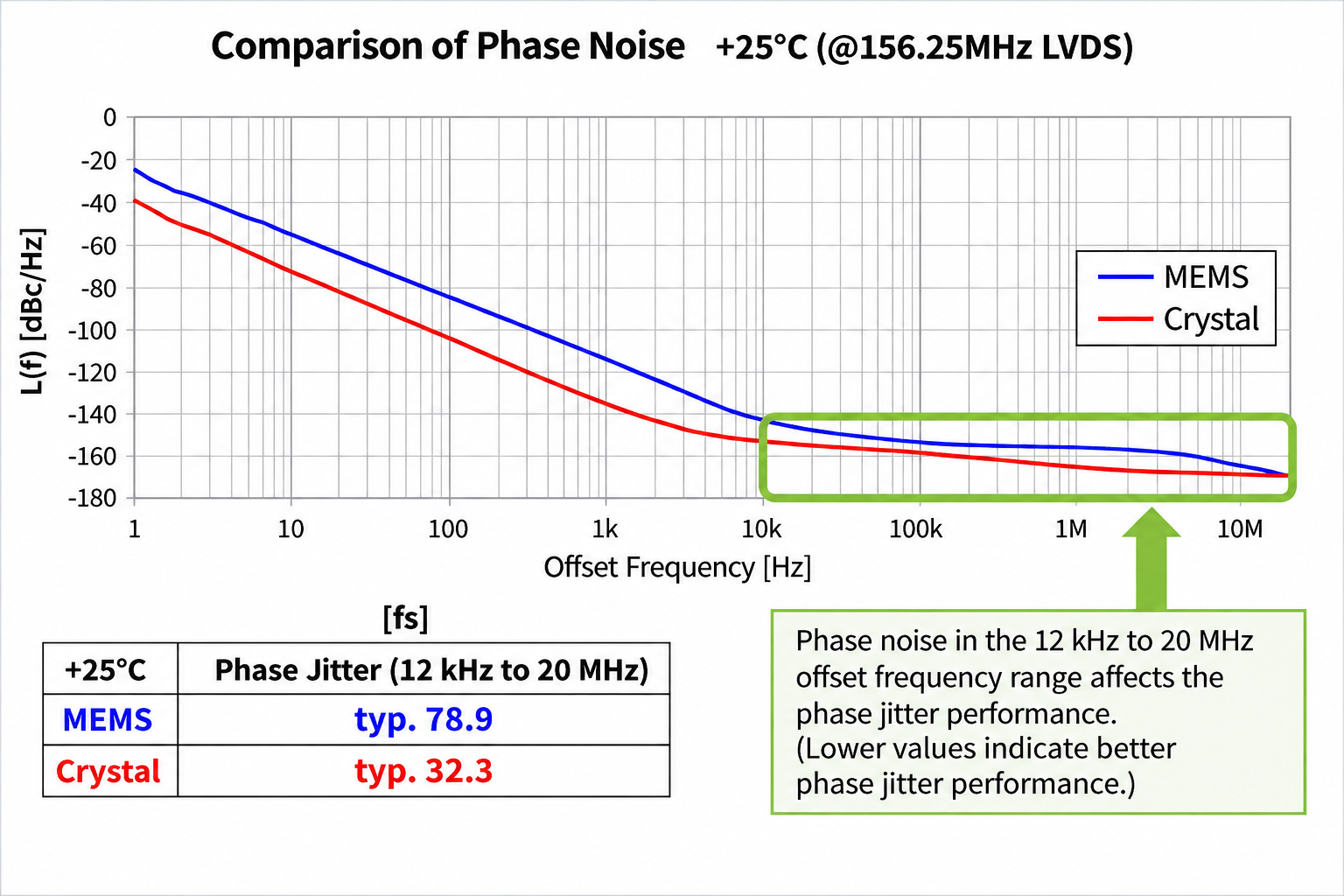
Phase jitter refers to fluctuations in signal timing, while phase noise refers to fluctuations in signal frequency. When these signal fluctuations become large, data errors are more likely to occur, which can lead to problems such as reduced data transmission speeds.
Crystal devices have characteristics that help keep these fluctuations low. In particular, differential-output crystal oscillators (SPXOs) with low phase jitter and low phase noise deliver excellent performance in high-speed, high-capacity communications. As a result, even during the high-speed, long-distance data transmission handled by optical transceivers within AI data servers, these oscillators can reduce data errors and improve communication reliability.
Advantages of Crystal Devices Compared with MEMS Devices
Crystal devices offer several advantages over MEMS (Micro-Electro-Mechanical Systems) devices. MEMS devices use an electronic circuit called a PLL (Phase-Locked Loop) to generate high frequencies. In circuits using a PLL, frequency multiplication is required to generate higher frequencies. As the multiplication factor increases, phase jitter and phase noise can also be amplified. In contrast, crystal devices can generate high frequencies without using a PLL, which enables them to maintain low levels of phase jitter and phase noise. This is one of the reasons why crystal devices are selected for high-speed communication applications.
Conclusion
Crystal devices play a vital role in high-speed, high-capacity communications. In particular, differential-output crystal oscillators (SPXOs) with low phase jitter and low phase noise are essential for reducing data errors and improving communication reliability. In the next article, we will take a closer look at specific applications of crystal devices in AI data centers and their future prospects.
※Click here for the previous article, “(1) The Evolution and Importance of AI Data Centers”
Contact Information
Inquiry related to IR TEL : 03-5453-6702
Inquiry related to our product
Inquiry related to our product TEL : 03-5453-6723
E-Mail:newsrelease@ndk.com